AI Pilot to Production: 3 Controls That Stop Stalled Pilots
Updated: Oct 1
Most AI pilots do not fail in a dramatic launch-day collapse. They stall quietly.
A team builds a promising prototype. Leadership likes the demo. A few users say it could save time. Then the project gets stuck waiting for cleaner data, clearer ownership, legal review, security approval, or proof that the model works outside a narrow test case.
Bridging the Gap in AI Implementation
While enterprise enthusiasm for artificial intelligence remains high, bridging the gap between a successful prototype and a live system remains a core challenge. Gartner predicted that at least 30% of generative AI projects would be abandoned after proof of concept by the end of 2025, and RAND notes that by some estimates more than 80% of AI projects fail. The usual causes are data readiness gaps, integration complexity, and unclear business metrics.
For associations, that might mean moving from a chatbot prototype to a reliable member-service assistant. For contractors, it might mean turning a bid-risk model into a tool estimators can trust during real proposal deadlines.
To learn more about how we can assist you, visit our Services page. Additionally, explore the various sectors we serve on our Industries page.
The difference between a stalled pilot and a production-ready AI system is usually not a better model. It is better project control.

Why AI pilots stall before production
The typical AI pilot starts with a good question: “Can this save time?” or “Can this improve decisions?”
That is a reasonable starting point, but it is not enough. A pilot can prove that something is technically possible while still failing every test that matters in production.
Production asks harder questions:
Can users trust the output?
Can the system handle messy real-world inputs?
Who reviews errors?
What data can the model access?
How will performance be measured after launch?
What happens when the model is wrong?
Who owns updates, retraining, and approvals?
These questions matter because AI behaves differently from traditional software. A normal workflow tool follows rules. AI systems infer, rank, classify, summarize, or generate. That makes them useful, but it also makes them harder to govern.
A practical AI pilot to production plan needs decision gates, data checks, and human oversight from the start.
Cause 1. Teams treat AI like a traditional software project
Traditional software projects usually start with requirements. The team defines the process, builds the system, tests against expected outcomes, and ships when the feature works.
AI does not fit that pattern.
The model’s performance depends on the quality of the data, the clarity of the use case, the tolerance for error, and the way people use the output. There may be no single “correct” answer. A member-support summary can be helpful but incomplete. A bid-risk score can be directionally useful but still miss a project-specific issue.
That creates a planning problem. Teams often write AI project plans as if the work is predictable:
Define the feature
Build the model
Test it
Launch it
That sequence skips the uncertainty that makes AI risky.
What this looks like for associations
An association may test an AI assistant that answers member questions using public website content and policy documents. The demo works well for common questions. Then the team discovers that production would require access controls, a freshness process for policy updates, escalation rules for sensitive questions, and a clear line between general information and professional advice.
The issue is not the chatbot. The issue is that the pilot treated content retrieval as the whole project.
What this looks like for contractors
A contractor may test an AI tool that reviews past bids and predicts which projects are likely to run over budget. The model finds patterns in historical data. But when estimators compare the output to current bid packages, they find gaps in scope notes, inconsistent cost codes, and missing context about subcontractor availability.
The pilot proved that the idea had promise. It did not prove that the tool could support a live bid decision.
Cause 2. Data hygiene problems show up too late
Data hygiene is not glamorous, but it decides whether an AI project can move forward.
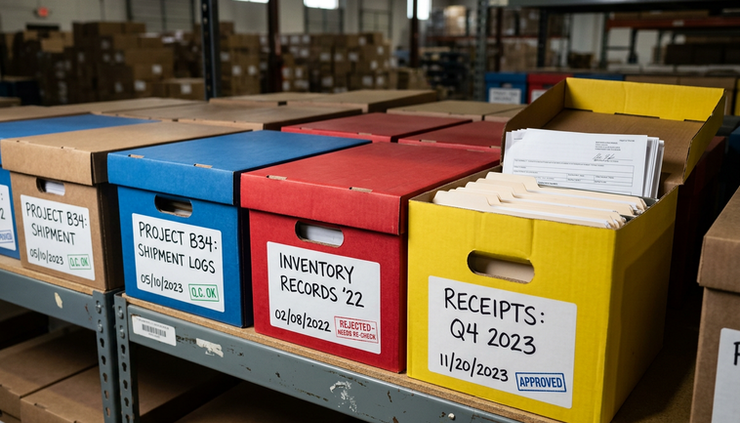
AI pilots often use a carefully selected sample. Production uses the real thing. That means old records, duplicate entries, inconsistent naming, missing fields, scanned documents, unstructured notes, outdated policies, and disconnected systems.
When these issues appear late, the project slows down fast.
Common data hygiene problems include:
Multiple versions of the same document
Inconsistent member, project, vendor, or job names
Missing timestamps or ownership fields
Poorly labeled files
Incomplete CRM or AMS records
Cost codes that changed over time
PDFs that are scanned images instead of readable text
Sensitive data mixed with general knowledge sources
AI does not magically fix these problems. In some cases, it amplifies them. A model trained or grounded on unclear data may give confident answers from outdated, duplicated, or irrelevant material.
Cause 3. The proof-of-concept trap creates false confidence
A proof of concept is useful when it tests one narrow question. It becomes a trap when leaders mistake it for launch evidence.
A polished demo can hide the hard parts:
The data sample was small and curated
The best cases were selected in advance
Users were guided through the workflow
Edge cases were excluded
The model was not tested against real operational volume
No one measured error cost
Legal, security, and compliance teams were not involved early
This is common because pilots are often built to win approval. The team wants to show potential. That is understandable. But a proof of concept should reduce uncertainty, not create a sales pitch for the next phase.
A better pilot answers this question:
What must be true for this AI system to be safe, useful, measurable, and worth maintaining?
If the pilot cannot answer that, it is not ready for production.
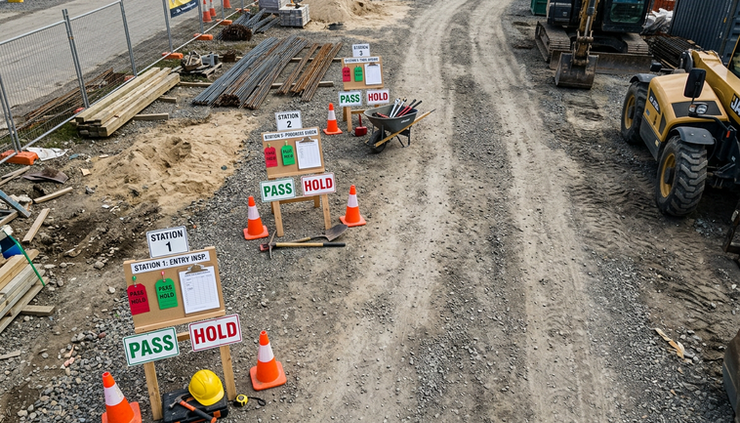
Control 1. Use a Go or No-Go feasibility gate
The first fix is a formal feasibility gate before major build work begins.
This gate should not be a long committee exercise. It should be a short, documented decision point that defines whether the project is worth piloting, what must be tested, and what would stop the work.
A good Go or No-Go gate covers five areas.
Gate area | What to decide |
Business value | The cost, time, risk, or quality problem the AI system is meant to improve |
Use case fit | Whether AI is needed, or whether rules, search, automation, or reporting would work better |
Data access | Whether the required data exists, can be accessed, and can be used responsibly |
Risk level | The impact of an incorrect output on members, bids, projects, safety, compliance, or finances |
Production owner | The person or team responsible after the pilot ends |
The gate should produce one of three outcomes:
Go
The use case is specific, the data is accessible, and the risk level is manageable.
No-Go
The project is not a good AI candidate, or the risk is too high for the expected value.
Revise
The idea has value, but the scope, data source, or review process must change before a pilot starts.
For an association, a Go decision might limit the first version to internal staff search across approved policy documents. For a contractor, a Go decision might limit the model to flagging bid documents for human review rather than recommending final pricing decisions.
That narrow scope is not a weakness. It is how AI projects earn trust.
Control 2. Score data readiness before the pilot
Data-readiness scoring turns a vague concern into a clear project control.
Instead of saying, “Our data is messy,” the team scores the data against the use case. That matters because data does not need to be perfect. It needs to be fit for the decision or workflow the AI system will support.
A practical data-readiness score can use a 1 to 5 scale across these categories:
Data category | What to check |
Availability | The needed records, documents, or fields exist |
Accessibility | The project team can access the data with proper permissions |
Accuracy | The data reflects current reality |
Completeness | Key fields are not missing at a level that harms the use case |
Consistency | Names, formats, tags, and categories follow usable patterns |
Freshness | The data is current enough for the decision being supported |
Sensitivity | Private, regulated, or confidential information is identified and controlled |
A score of 5 does not mean the data is perfect. It means the data is ready enough for the defined pilot.
A score of 2 does not mean the project is dead. It means the team should fix the data first, reduce the scope, or choose a lower-risk use case.
A practical example for associations
If an association wants an AI assistant to answer member questions, the data-readiness score should review:
Which documents are approved sources
Who owns each document
How often each source changes
Whether outdated pages remain online
Which topics require staff escalation
Whether member-only content needs access controls
A practical example for contractors
If a contractor wants AI to flag bid risk, the score should review:
Historical estimate quality
Consistency of cost codes
Availability of final project outcomes
Completeness of scope notes
Change order data
Links between bid assumptions and actual job performance
This step often reveals that the best first AI project is smaller than expected. That is a good result. Smaller, cleaner AI projects are more likely to reach production.

Control 3. Put human-in-the-loop governance around measurable KPIs
AI production does not mean removing people from the process. For most association and contractor use cases, production means giving people better support while keeping them accountable for final decisions.
Human-in-the-loop governance defines where people review, approve, correct, or override AI output.
This control should be designed before launch, not after an error.
Good governance answers:
Who reviews AI output?
Which outputs require approval?
What confidence level triggers review?
What errors must be logged?
How will users report bad answers?
Who updates approved source material?
When should the system be paused?
The key is to connect oversight to measurable KPIs. Without KPIs, governance becomes a policy document no one uses.
Useful AI KPIs include:
Response accuracy against approved source material
Human override rate
Escalation rate
Time saved per task
User adoption by role
Error severity
Rework caused by AI output
Percentage of outputs reviewed
Time to correct known issues
For an association, a member-service AI assistant might track answer accuracy, escalation rate, and staff correction volume. For a contractor, a bid review assistant might track false positives, missed risk items, estimator override rate, and time saved during document review.
The point is not to chase perfect automation. The point is to create a system that learns safely, with clear ownership and a feedback loop.
The three controls work best together
Each project control solves a different failure point.
Stalling problem | Project control that prevents it |
The team treats AI like normal software | Go or No-Go feasibility gate |
Data problems appear late | Data-readiness scoring |
The proof of concept creates false confidence | Human-in-the-loop governance with KPIs |
Used together, these controls create a stronger path from idea to production.
The feasibility gate asks whether the project should start.
The data-readiness score asks whether the project can work.
The governance model asks whether the project can be trusted after launch.
That sequence prevents wasted effort. It also gives leaders a clearer way to compare AI ideas. Instead of funding the flashiest demo, they can fund the use case with the best mix of value, data readiness, risk control, and ownership.
A Monday morning checklist for stalled AI pilots
Use this short checklist before the next AI pilot meeting.
Name the production decision
Write the exact workflow, decision, or task the AI system will support.
Define the stop rules
List the risks, data gaps, or performance failures that would pause or end the project.
Score the data
Rate availability, access, accuracy, completeness, consistency, freshness, and sensitivity.
Identify the human reviewer
Assign the role that approves, corrects, or overrides AI output.
Choose three KPIs
Pick one quality metric, one adoption metric, and one risk metric.
Test real edge cases
Include messy records, unusual member questions, incomplete bid documents, and outdated source material.
Decide what production means
Define the minimum level of reliability, oversight, documentation, and support required to launch.
If the team cannot complete this checklist, the project is not ready to scale. That does not mean it failed. It means the pilot found the next constraint.
Free AI Readiness Audit
Before investing more time in another proof of concept, run the project through a readiness review.
The Free AI Readiness Audit is designed to help identify whether an AI use case has the right scope, data foundation, governance plan, and production path. It is especially useful for associations evaluating member-service, operations, or knowledge-management tools, and for contractors evaluating estimating, document review, project controls, or risk workflows.
Use the audit before a pilot starts, or when a current pilot is stuck between demo and deployment.
The takeaway
AI pilots stall when teams mistake a working demo for a production-ready system. The fix is not more hype, more tools, or a larger model. The fix is stronger control over feasibility, data readiness, and human oversight.
A good AI pilot should answer three questions before production:
Should this AI project move forward?
Is the data ready enough for this use case?
Can people govern the system with clear KPIs?
When those answers are documented, the path to production becomes clearer, safer, and easier to defend.

Comments